Showing posts with label superman. Show all posts

Thursday, April 7, 2011

SUCKER PUNCH: The Year’s Biggest Disappointment (hopefully)

SPOILERS! SPOILERS! SPOILERS!

Introduction


When the trailers for Zack Snyder's Sucker Punch first hit theaters/the Internet, it became one of this year's most anticipated movies, getting more interest than many of the upcoming Marvel properties and DC's Green Lantern. Hot chicks in the 1950s/60s (around the time of Girl, Interrupted) going on crazy adventures in a dilapidated mental hospital (compared by some to Sam Fuller’s Shock Corridor) contrasted against outlandish and brightly colored dream sequences developed by a very visually adept director (The Wizard of Oz comparisons are easy). People didn't really expect art, but many expected a good time. A non-comic book property that would appeal to fanboys, maybe some sort of female empowerment tale that would also appeal to fangirls. Yes, the T+A+E(xplosions) were there, but there was a near universal hope and expectation of something greater. With the team of rebel girls concept, I was personally expecting something with elements of 1996’s The Craft.


When people finally saw Zack Snyder's Sucker Punch- well, let's just say the 300 and Watchmen (which I maintain is the best comic book movie ever made) filmmaker probably thanked God he already signed the deal to direct the upcoming Superman reboot. Oddly enough, Sucker Punch is in many ways like Superman Returns. An epic scope, a respected and proven director, seemingly interesting source material, and so many things seemed to click- that is until we saw the movie.

Both films are mistake upon mistake upon mistake. Dialogue, characters, plots, themes-everything went wrong. These aren't movies you dislike. These are movies you nitpick, these are movies you passionately discuss with people who hate them just as much as you do to just so you can cover every base of what failed.

Unlike Superman Returns, however, it's difficult to imagine any defenders of Sucker Punch. To put another way, more people probably liked Superman Returns, and at least Sucker Punch seemed to take the stance that rape is bad.


What Went Wrong?


Smarter people than myself have written tomes about the “hero's journey.” The centerpiece to most fiction, the character arc is essential to a story. The journey doesn't have to be good, it doesn't have to lead to a happy ending, and the audience does not necessarily have to identify with the “hero” - but there has to be something. Sucker Punch presents the bizarre situation where there is no hero's journey. And I don't mean a bad hero's journey or a poorly thought out one, but I mean no hero's journey at all. In fact, this movie takes it to an entirely different realm where the time between the first ~20 minutes (after we enter the brothel reality) and the last ~5 minutes (after Baby Doll gets lobotomized) is totally irrelevant.


Description


I guess I should explain the film at this point in the review. Extensive spoilers. Feel free to skip it.

Like Inception, the film is split into three realities. Reality 1 involves Baby Doll (Emily Browning), a young girl forcibly committed to a mental hospital by her step-father. This occurs after he discovers Baby Doll's mother, whose death kicks off the movie, left her entire inheritance to her two children in her will. Angry, the stepfather tries to rape Baby Doll before trying to molest Baby Doll's younger sister. Baby Doll then attempts to shoot him, accidentally killing her sister in the process. I know I'm making it sound bland, but it actually is by far the best part of the film, which probably sounds like a backhanded compliment but it shouldn't. The sequence was atmospheric, chilling, and an excellent introduction to a film that didn't even try to live up to it.

The hospital is run by Carla Gugino's Dr. Vera Gorsky, a psychiatrist who seems to care about her patients and utilizes alternative forms of therapy, such as dance. Baby Doll's stepfather bribes an orderly named Blue (played by Oscar Isaac and sounding like Action’s Jay Mohr) to have her lobotomized in five days.

Then the hospital becomes a brothel where Baby Doll meets four other patients Sweet Pea (Abbie Cornish), her sister Rocket (Jena Malone), Blondie (Vanessa Hudgens), and Amber (Jamie Chung). Blue becomes a pimp and Gorsky becomes a dance instructor/Madame that acts and sounds like Bart's ballet instructor in that episode of The Simpsons where Homer drives the limo with Mel Brooks.


The only difference between Real Reality (Reality 1) and Brothel Reality (Reality 2) is that the sets kind of changed. There’s no noticeable change in filming style, camera movements, coloring, etc.; it’s still dark and dim and lifeless. I admit originally thinking that the mental hospital was just a front for a whorehouse and that the “show” at the beginning was so the people admitting the patients didn't think “oh wait, I’m sending my disturbed teenaged daughter to a whorehouse. I am probably entitled to a percentage of her whore fees.”


At this point, the film doesn’t (or if it does, it’s very rare and negligible at best) return to Reality 1 until the very end. This leads to a question asked by many viewers: “Why is a brothel (and forced sexual servitude) better than a mental institution?” It’s a query that implicates a lot of darkness but it can be answered, albeit not by the scenes in this movie.


Then, Baby Doll has to dance (to make her lucrative to potential Johns) and her “dance” is so ridiculously sexy that it puts everyone into a hypnotic trance. During her dances, she enters the dream worlds (Reality 3) that make up most of the trailers where she's fighting Germans, dragons, robots, and other zany stuff. Also in Reality 3, the Wise Man (Scott Glenn) briefs them on every mission.


In Reality 2, the dance is meant to distract guards so her fellow inmates can get the objects they need to escape (map, fire, key, knife, and a question mark). The bulk of the movie is then made up of ‘determine object  dance/action sequence  steal object  end dance’, and it very redundant. Nevertheless, I will go into depth about it later.


Long story short, Rocket gets stabbed by a chef, Blondie and Amber get shot by Blue, Baby Doll stabs Blue, and Sweat Pea escapes as Baby Doll lets herself be caught. All of this takes place in Reality 2. As for Reality 1?

We cut back to Reality 1 as Baby Doll is getting lobotomized. Dr. G. calls her a handful because she helped a patient escape, and Dr. G finds out that Blue forged her name on the lobotomy papers, which she probably should have realized earlier but whatever. Blue (who was, in fact, recently stabbed) gets arrested, Sweet Pea (in Reality 2 presumably) gets on a bus driven by Scott Glenn as the Wise Man, and a closing narration from Dr. G. tells us to believe in ourselves, fight for our future, and all that hogwash.

What Went Wrong? (redux)


In other words, everything between “then the hospital becomes” and “We cut back to Reality 1” is meaningless. All we know about the bulk of the movie is that Baby Doll stabbed the orderly and a patient escaped.


False Depth/Whose Story Is This?


Sucker Punch is one of those movies that attempts to force weight into its hollowness by throwing out random terms and potential themes in hopes that at least one will connect with the audience. Ideas like guardian angels appearing in random guises throughout one's life, the question of “whose story is this,” and fighting for reality are casually used but never truly explored. The film even uses the “narrator telling the audience to believe in themselves over a black screen at the end” trick, which also found favor in this year's lackluster The Adjustment Bureau (another disappointing Philip K. Dick adaptation), which was also about fighting for one’s future/reality/free will/whatever.

None of these thematic claims make any sense within the context of the film. For example, at the end of the film, Baby Doll helps Sweet Pea escape by sacrificing herself after realizing that “this is her [Sweet Pea's] story.” But is it?

The way the film is set up, without allowing us to have any significant Reality 1 moments with any of the characters (including Baby Doll, opening sequence aside), the most likely candidate for whose story the film is about is Dr. G. At the beginning of the movie, Dr. G. is presented as a psychiatrist who cares for her patients. At the end of the movie, she realizes that one of the orderlies is forging her signature and getting patients lobotomized for some quick cash. That is the most complete story for anyone in the film.

Apropos of nothing, Abbie Cornish starred in this year’s surprisingly enjoyable Limitless.

I just realized that Sweet Pea and Sucker Punch have the same initials. Maybe it really was her story.


But what about Sweet Pea’s escape? Well, do we know if Sweet Pea escaped? All we know, according to Dr. G., is that Baby Doll helped a patient escape. It could have been any one of a dozen patients, including the “dead” Rocket, Amber, or Blondie because we do not know if any of those three actually died. It's doubtful considering how nonchalant Dr. G. was during the lobotomy sequence. You'd think if one of her patients died, let alone three of them, a couple of days earlier she'd show some sort of emotion about it. At least there should be police investigating several brutal murders the day before. Or, when Dr. G.'s discussing how Baby Doll was such a handful that she helped one patient escape, she'd throw in “and killed one (or two or three) others.” Of course, she also didn't mention that Baby Doll stabbed an orderly, so who knows?


Additionally, since Reality 2 Rocket's death spurred Reality 2 Sweet Pea onto her Reality 2 escape, Rocket 1 Rocket possibly (probably) not dying further challenges what happened at the end. Considering how we can never be sure of how Reality 1’s characters mesh with Reality 2’s characters (e.g. Reality 2 Sweet Pea would never abandon her sister), Sweet Pea's escape could be a very bad thing indeed. She could, in fact, be a very damaged and dangerous girl roaming the streets unable to deal with the real world.

Fighting for one’s reality, the most over used motif in the film, also doesn’t work in Sweet Pea case. The one who “escaped” spent most of the movie bitching and moaning about the escape plan and barely did any “fighting.”


The Fantasy Sequences

Yes, they looked (mostly) great and Zack Snyder has a distinctive visual eye but, as this film proved, so what? By the dragon sequence, I was already bored and half-annoyed because there were no stakes in Reality 3 and, when you accept that Reality 2 is similarly fake, no stakes there either. But with dream sequences, you don't really expect anyone to die, which is why in most films dreams symbolize something. Anything. This film had perfect openings to explore different avenues of Baby Doll's psyche as theoretically these sequences represented therapy sessions, but Snyder didn’t even seem to attempt to try. Hell, A Nightmare on Elm Street 3: The Dream Warriors did it better.


When Baby Doll enters her first fantasy world, she receives her weapons (a sword and gun representing nothing other than chicks with swords and guns are hot) from Scott Glenn and fights giant samurai men (like in Terry Gilliam's masterpiece Brazil) with machine guns (unlike in Terry Gilliam's masterpiece Brazil). Do these Samurai men represent anything? I don't know. Her home didn't seem to have any Japanese mementos. Could her stepfather have fought in the Pacific? Maybe. Could the Samurai men have represented something? Definitely. Her step father. The orderly. Other bits of evil sprinkled throughout the film. For a film that had the makings of a female empowerment tale, destroying giant men could have been a great first step down that path. But it wasn’t.


The second fantasy world involves a quest for a map. While Reality 2 Sweet Pea gets the map of the hospital in Reality 2, Reality 3 Baby Doll brings her own version of Sweet Pea and the other gals on a quest in World War 1 to get a map. (No, the Reality 3 and Reality 2 sequences never match up in any way.) I am a fan of World War 1. Well, fan is an odd word. I personally find World War 1 the most fascinating war. A lot of great art came from the experiences of The Great War: All Quiet on the Western Front, Johnny Got His Gun, The Grand Illusion, Paths of Glory, Black Adder Goes Fourth (you think I joke but that final episode is chilling), so a tripped out take on that war was actually something that could have been unique.

But it doesn’t fit. See, for a teenage girl in the late 1950s/early 1960s, World War 2 wouldn't merely be more recent, it would very well be something she witnessed. And while I would love to see more work about World War 1 (or, as in this case, World War 1 by way of Castle Wolfenstein), this should not have been the film.


Fantasy world three concerns getting fire to cause a distraction*. Reality 2 had Amber seducing an evil naughty mayor to get his lighter while Baby Doll did whatever the hell she does. Reality 3 had the gang fighting dragons to get crystals that would ignite a flame. To get the crystals, Baby Doll slays a baby dragon then must slay its mother. Decent enough concept, except the movie began with the death of Baby Doll's sister and mother. The parallels aren't just easy, they're ridiculously blatant. Not picking up on them (or, probably more accurately, not doing anything with them) requires amazing skill.

* In Reality 2, getting the flame is the difficult task despite one of them working in the asylum kitchen, which probably requires matches to light the stove. Anyway, the distraction occurs when Baby Doll and Sweet Pea light a Molotov cocktail and burn a room. Getting the flammable liquid requires literally no effort whatsoever.


The final fantasy world revolved around obtaining a knife. In Reality 2, Baby Doll sought to get a knife from the kitchen by seducing a chef with her dancing. In Reality 3, the gang is on a high speed train with a bomb about to explode a major city while fighting robots. For whatever reason, I thought about Heavy Metal during this portion, but that's neither here nor there.


The 1940s and 50s were chock-full of classic science fiction/alien films with a distinctive visual style, many of them focusing on Earth’s threat of annihilation as an allegory for the Cold War. Films like The Day The Earth Stood Still, The Thing From Another World, When Worlds Collide, and Invasion of the Body Snatchers as well as B-movies and serials like Attack of The The Eye Creatures, Teenagers from Outer Space, and Buck Rogers probably would have found an audience in Baby Doll. So her fantasizing a future with the sheen of a 2011 film, I found kind of disappointing. I spent more time wondering if Baby Doll was prescient than enjoying her escape from the hell that was her life.

It is also during this sequence that Reality 2 Rocket gets stabbed (Reality 3 Rocket martyrs herself with the bomb) when Reality 2 Baby Doll stops dancing. But Reality 2 Baby Doll keeps dancing after realizing that Reality 2 Rocket was stabbed, which removes emotional impact by forcing you to wonder a) how close to Reality 1 Reality 2 is or b) maybe Baby Doll really is just nuts.


For those who haven't seen the movie but want to get a feeling about what these sequences were like, let me help you. Scott Glenn explains the mission. Shoot. Shoot. Shoot shoot shoot. Stab. Scream. Stab. Stab. Shoot shoot. Scream. Danger? Danger averted. Shoot. Stab. Pose.


Like I mentioned above, because all this is happening in Reality 2 Baby Doll's mind, nothing really happens or can really happen to the characters. When I first saw the trailers, I thought these moments would be closer to some sort of mass hallucination the characters engage in while on their quest for the object with the enemies some exaggerated-but-“real” threat. Or some sort of delusion from one of the characters putting their bland lives in an over-the-top situation but still involving the Reality 1 characters. After all, if the Reality 1 characters were all participating in Reality 3, then we might get some character development. I mean, what's more typical in a war movie than characters bonding during the battle? And in this movie we had four battles. As the movie stands now, not even the Reality 2 characters are in Reality 3. .


Also disappointing is that we never got to see the items used together. We never got the World War 1 map mixed with the dragon fire crystals, but I digress...


Other Nitpicks


There are a lot of other things to bitch about with the movie. The dialogue is horrendous and many scenes, especially Reality 3 scenes, would have been better served had it been mostly silent except for Scott Glenn's exposition and occasional grunts. Even little sentences like “Get down!” could have been removed to create a better effect. Similarly, maybe Baby Doll should have spoke as little as possible, as she was completely silent for most of the first part of the film. Her saying random nothings lessened the allure of the character.

Why was Amber the pilot in every fantasy? Did they ever show her to have any interest in aviation?

Why did they all wear the same outfits in every Reality 3 sequence?


Summing Up


Sucker Punch is not just a catastrophe, but a startling one, which makes it an interesting one. For a movie set in a mental hospital, it's ironically beyond analysis. It's empty to a fault, pointless without having a quirkiness or cleverness to fall back on. Nevertheless, the mistakes it made, everything it did wrong (and it did everything wrong), makes for a fun discussion.

While I'm sure that there are people who enjoyed the movie and will use the argument “well critics hated it, the audience hated it, but plenty of cult classic movies started out that way and now they're beloved!” But most of the time, movies hated by critics and audiences alike just end up eternally despised. The only way this movie can be the next Blade Runner is if the sure-to-come director’s cut does to Sucker Punch what Ridley Scott’s director’s cut of Blade Runner did to that film. This is not impossible, just very, very, very, very improbable.

Monday, October 18, 2010

SHORT REVIEW: Jonah Hex- A Call For a Re-Imagining/Reboot/Whatever


Superhero movies do not need to merely be action movies. Just because the protagonist wears a costume does not mean that these films are only meant to throw as many explosions and effects at us as possible. Superhero movies can become a genuine crime thriller (The Dark Knight), or an epic,(Watchmen), or a Lifetime movie about a stalker date rapist (Superman Returns).


Jonah Hex, the 2010 bomb staring Josh Brolin and Megan Fox, is a flat-out terrible movie. Yet, for a film that pretty much failed on every conceivable level (some casting (such as Brolin, Michael Fassbender, and Jeffery Dean Morgan) was okay), within the concept of Jonah Hex and the Hexverse lies the potential for a truly great film.


Note: I have never read a Jonah Hex comic, and my first introduction to the character was through the film.


(Brief background: Jonah Hex is a former Confederate soldier bounty hunter in the late 1800s terribly scarred on half his face. In the comics, he has no special powers, although he is an excellent marksman and tracker. In the movie, however, he can talk to the dead for a short period like that guy in Pushing Daisies.)


While the talking to the dead angle of his character is a cinematic invention, it makes you wonder about a Jonah Hex film done as a respectable supernatural western.


If you look at the history of the genre, the great Westerns never move quickly, an idea that the 80-minute Jonah Hex never bothered to understand. Films like The Searchers (and other John Ford films), The Good, The Bad, and the Ugly (and other spaghetti Westerns), The Wild Bunch, or the post-Unforgiven series of modern Westerns, bide their time. The films are as much about the ambiance of the landscape and the scenic vistas as whatever quest the anti-hero protagonist undertakes. After all, when all you have is a horse and a vast terrain in front of you, time basically becomes irrelevant. And, while these films had gun fights and the occasional dynamite-caused poof of black smoke, simply shooting a lantern didn't make shit explode, as in this film.


(A minor complaint but the climax of Jonah Hex takes place on a boat and anyone who knows anything about the Western genre knows that it's the railroad that the true enemy.)


A supernatural angle should be less about fighting ghosts and goblins as though Jonah Hex was Ash from the Evil Dead series, but more about mysticism, spirits, and how the life after death surrounds us at all times.


And there is one person who would be perfect for this sort of film: Nick Cave.


Listeners of the songwriter/singer know how well he uses dark, vivid imagery of death and other morbid subjects. And, equally important, his history with the cinema shows a definite attraction to the Western.


The Proposition, which he scripted, is probably the best Western of the past decade. Along with Warren Ellis, Cave co-wrote the hauntingly beautiful score to 2007's underrated Western The Assassination of Jesse James By The Coward Robert Ford.


Other films that Cave has been linked to as a screenwriter include a reboot of The Crow, and a bizarre yet interesting sounding sequel to Gladiator that finds Maximus contending with Roman Gods and reincarnation. http://www.guardian.co.uk/music/2009/may/06/nick-cave-rejected-gladiator-script


In the coming years, plenty of big named comic book heroes will be getting a second shot at fame. Reboots include Spider-Man (starring Andrew Garfield, Emma Stone, and Rhys Ifans), Superman (directed by Zack Snyder), The Fantastic Four, Daredevil, and we've already seen The Hulk attempt big screen success twice.

With so many others getting chances, why not give Jonah Hex a second go-around?A film combining the slow, methodological approach of the Western with an intrinsic understanding of the darkness of mortality, could be among the top films to showcase the untapped versatility of the comic book/superhero genre.

Monday, September 20, 2010

SUPERMAN III


There is an old adage that says “death makes saints of us all.”

One needs only look at Michael Jackson to see a recent example. People were calling for a National Day of Mourning over the death of a man who, for over a decade, was primarily known as a creepy child molester.


Upon viewing “This Is It!,” may rued that they never got a chance to see M.J. In concert, knowing full well that had Jackson lived, they wouldn’t have even accepted free tickets to the show.


Even at his best, he was just guy who danced well. And for that they interrupt regular television programming to show his funeral?


And, of course, there was that brief period in the 1950s when all the kids were doing The Hitler.


After Christopher Reeve had his tragic accident and subsequent death, people looked towards his portrayal of Superman with red, blue, and yellow-colored glasses. Praising his performance and the man as though he really was the Man of Steel.


To be entirely fair, Christopher Reeve is by far the best live action Clark Kent/Superman. For all the jokes made about “how can't people tell!? He's just wearing glasses!,” Reeve managed to give enough life to both personas to turn them into totally different people.


Then again, what is his competition? Brandon Routh having to do a two-bit impersonation of Christopher Reeve? Tom Welling? Dean Cain? George Reeves?

Unfortunately, the major problem is that despite his decent performance, overall the Superman series was not that good. Well, the first two were kind of decent, though flawed in their own ways. But the second two were terrible. I mean “worst movie of all time”-worthy terrible. And just because Christopher Reeve got paralyzed, doesn't make this


or this


or this


Any more palatable.

My original scheme was to cover both Superman III and Superman IV: The Quest For Peace in this article but after the two hours and four minutes spent watching Superman III, I decided just to focus on the third leg. Superman IV will be covered eventually and, for that matter, probably Superman Returns, but this is not just going to be a blog on bad superhero movies, though there are plenty to choose from.


For now, onto the five biggest problems of 1983’s Superman III.


1) Richard Pryor


Richard Pryor is an undisputed comedy God. Not merely a legend, but an icon. Among the world of stand-ups, only George Carlin might be held in slightly higher regard.


He was responsible for the classic Saturday Night Live “word association” sketch, and co-wrote the Mel Brooks classic Blazing Saddles.


Throughout his life, he even had a somewhat decent movie career. Not as good as Eddie Murphy's, but decent nonetheless.


However, most of his biggest cinematic successes as a star came after Superman III (like Brewster’s Millions (1985)), or featured Gene Wilder (Silver Streak (1976), See No Evil, Hear No Evil (1989).


Prior to Superman III, Pryor had small roles in films like Lady Sings The Blues, The Mack, Car Wash, and The Wiz (as The Wiz), and starred in a couple of movies like Greased Lightning, Which Way is Up, and Blue Collar, but nothing that answers why he should be the main villain in a superhero film.


And don’t think that Pryor's performance as Gus Gorman is an unexpected turn of nefarious villainy, like Heath Ledger as The Joker. Gorman is essentially a bumbling fool, a dope. Imagine Batman fighting Chris Rock or Dave Chappelle at their most broad.


Also, not only is Pryor the main villain, but the film very often seems like a vehicle for him. His name is above the title, he’s as relevant as Superman on the movie poster, and, if I had to guess, he’s probably on screen as much as Reeve, if not more.


Who is Gus Gorman?

The best way to discuss the film itself is by going through the adventures of Gus Gorman.


As soon as the film begins, we see Gorman at the Metropolis Department of Health and Human Services where he is losing unemployment benefits after 36 weeks of chronic joblessness. Inspired by a matchbook ad for a computer programming school, he goes to class and finds himself a genius at computers (read: good at coding). And by genius at computers, I mean via the lack of understanding of computers that characterized most movies of the 80s and 90s. You remember, where typing fast means you're a hacker.


Gorman gets hired by Ross Webster (Robert Vaughn), a rich Metropolis billionaire who is a pathetically unconvincing Lex Luthor stand-in.


He even has his own Miss Tessmacher


and some chick who looks like Frau Farbissina from Austin Powers.


Webster recognizes Gorman's innate talent and, because that the world is run by computers, Webster wants to use Gorman for his own nefarious deeds, like using the United States Vulcan Weather Satellite computer (located in Smallville) to destroy the coffee crop in Columbia for financial gain.


Gorman doesn't really have a reason for doing this. Webster doesn't promise him riches, Gormanburgh, or fame. Nor does Webster blackmail him into performing these acts (beyond “I'll fire you,” which really isn't much incentive). But he does it anyway. If they bothered to give Gorman understandable motives, it could have been an interesting side to the character and one, I believe, that Pryor could have sold. While Webster is doing bad for greed, Gorman is doing it to screw the system that screws him. Instead, unfortunately, he’s merely a buffoon.


Anyway, Gorman goes to Smallville to use the computer. After defeating the computer guard in an embarrassing drinking contest sequence, Gorman manages to wrangle his way into the computer that controls the satellite, and cause weather patterns to wreak havoc.


Bizarrely, simultaneously, while fucking around with the computer late at night in Kansas, it screws up the mail somewhere in America. We see a husband receive a $200,000 Bloomingdale's bill and smashed a grapefruit in his wife's face in a pathetic ripoff of Edward G. Robinson in Little Caesar.


Not nearly as funny as the child abuse scene in Superman: The Movie when the father smacks his daughter for talking about Superman saving her cat from a tree


and a traffic jam in the middle of the day somewhere, presumably, in America.


Not happy to leave well enough alone, Superman saves the coffee crops, thus defeating Webster's scheme. Gorman prances around Webster's apartment on skis and with a make-shift cape praising the awesomeness of the Man of Steel, pissing Webster off.


Webster's new goal, of course, is to destroy Superman. To do this, the plan is to make artificial kryptonite and, for some reason, that's Gorman's job. Why a computer programmer suddenly becomes a chemist is anyone's guess, but Gorman goes to work figuring out the necessary components to create Kryptonite.


Unable to figure out a missing element in the molecular breakdown of Kryptonite, Gorman, inspired by a package of Camel cigarettes, chooses tar. A not-so-subtle anti-smoking message,


Tar, by the way, not on the periodical table of the elements.


While Smallville is honoring Superman, Gorman (in a douche-chill inducing sequence cribbing from Patton and Dr. Strangelove) appears as a United States General to award Superman the fake Kryptonite.


Superman happily accepts it even though the thing looks exactly like the green crystals of doom. Since everyone knows Kryptonite is his main weakness (he admits it to the public in the first film), I don’t think anyone would hold it against him if he didn’t take the award.


The Kryptonite, while it doesn't kill Superman, does make him evil and more on that later.

Gorman goes to Webster with plans to build a super-computer that will do everything every computer can do and 1,000 things they cannot. Again, Gorman is a good coder (even if he doesn't entirely seem to know what he’s doing), but not the type of genius necessary to create such a massive, groundbreaking piece of equipment.


Blueprints


Superman battles the computer, and the computer synthetically creates perfect Kryptonite to kill him.


While watching Superman die, Gorman suddenly has a change of heart. For some reason, in a lot of Superman films, bad guys will suddenly grow a conscience when seeing Superman in pain. Despite the millions of lives their actions have ruined, seeing Kal-El writhing is what makes them grow a soul. I find it curious and unconvincing.


Anyway, Gorman tries to shut down the computer, but it comes back to life, and Superman eventually defeats it. More on the computer sequence later.


With the computer destroyed, Superman leaves Webster and his ladies to get arrested by the police, and flies away with Gorman in tow leading to this exchange.

Gorman: “What's going to happen to Websters and the other two ladies.”
Superman: “They're going to have to see the police now. Not your problem anymore.”


Then he drops him off at some sort of rock quarry and even gets him a fucking job.


Why is this in black and white?


This makes absolutely no sense.

Why isn't it his problem? Sure he didn't do as many bad things as Webster, and possibly not as many bad things as Frau Farbissina throughout her career, but he is certainly more culpable than The Second Miss Tessmacher, who also showed remorse.


And got this weird womb bullet from Frau for her troubles.

Gorman was in his right mind when he started to do villainy. While I'm not saying that Gorman should be punished as severely as someone like Webster, it is not up to Superman to decide that he should escape prosecution. He didn't let poor Otis go free...


Speaking of Otis…


One of the most interesting things about Gorman being the starring villain is that the film’s major bad guy is actually a dopey henchman. Gorman’s kind of an idiot, he bumbles and flails around, and seems like a pawn in Webster's games than rather a criminal mastermind. Gorman’s not really malevolent, but it's not like he's under mind control either. The best way to explain this element is that it’s like if the first two Superman movies focused on Otis instead of Lex Luthor. (Otisburgh, still one of the best fictional towns ever.)


Keep in mind too that this film is Superman III, meaning that its direct predecessor was Superman II. Meaning that the villain before Gus Gorman was General Zod, one of the all time great superhero movie villains and possibly one of the greatest villains in cinematic history. With the exception of Reeve, Stamp's performance as the disgraced Kryptonian leader serves as the most memorable in all five Superman films.


To sum up, and hopefully someone better versed in Superman movie lore can explain this to me, why does Richard Pryor, who hadn't really had a major hit up until that point, share top billing with Superman. Why does he gets a happy ending? And why does so much of the movie focus on him and his schemes?


2) The Opening Sequence


After we're introduced to the star of the film, Richard Pryor, we go to the streets of Metropolis for what amounts to a ridiculous, unfunny, over-5-minute-long slapstick sequence featuring Rube Goldbergian zaniness with a burning toy penguin,

a blind guy losing his dog and pushing something,


a car unrealistically filling up with water from a fire hydrant,


and all the silly horseshit even Jar Jar Binks would be ashamed of, while the opening credits scroll. A long way from the names appearing through the vastness of space.


http://www.youtube.com/watch?v=treSUFrKR1w

embedding disabled...


This sequence does not begin cute and eventually wear out its welcome. From the first cringe moment, you realize you're in for a half-assed attempt at comedy, and can only ask yourself when this Mel Brooks' Silent Movie knock off will be over.


Several minutes into this embarrassment, there's even a brief shoot-out and bank robbery.


Obviously, you'd expect Superman to appear here, but he doesn't. He appears slightly after the criminals get away unscathed, in order to save a man drowning in his car after he runs over a fire hydrant. Yet even after the money shot


The sequence continues. A bald man gets paint dripped on him..


And then a bucket falls on his head


And then there's a mime.


And a blind guy walks through a painting


It doesn’t end until a guy gets hit in the face with cake.


I wonder what 1983 audiences thought when they watched Superman III. Today, no matter how many superhero movies come out, there's still a level of excitement on opening day. You want to be sucked in, you want amazing visuals, you want moments that wow you. And a lot of superhero films try to produce such things.


But what about Superman III? Audiences anxious in their seats, excited to see the new adventures of the Blue Boy Scout, only to come face-to-face with a man arguing about unemployment benefits and glorified extras doing pratfalls? Obviously, the nerd contingent wasn't as strong back in 1983, but it was still there. I also cannot imagine that regular expectations would be that low, considering how highly regarded Superman II still is. Were audience sensibilities so low 27 years ago that the filmmakers athought people would like this? Did people like this never-ending Hack Sennett routine?

It must be noted that this movie was released on June 17, 1983 less than a month after the third part of another trilogy...


….so who could blame them for not trying?


3) Superman v. Superman


When not spending time with Gus Gorman, there's another character in the film: Superman. Superman's big plot is that he goes EEEEEEEEEEEEEEEVILLLLLLLLLLLLLLL (for like 20 minutes) because of Gorman's synthetic Kryptonite.


How Evil? Well, he does not care about when people are in danger...


gets forward with Lana Lang (more later)...


straightens the Leaning Tower of Pisa, upsetting the racist stereotype selling souvenirs...


blows out the flame for the 1983 Olympics...


bangs a lady...


makes oil spill out of a ship at the behest of Webster.......


looks dirty....


frowns…


drinks....


frowns some more…


and uses peanuts to break glass bottles.


With the exception of destroying the boat (which he only does because of some coaxing), you'd think that a creature of unlimited power becoming pure id would do a lot worse. Like dance like an asshole.


It never gets easier the more you watch it


Eventually his conscience gets the better of him and, after a melodramatic scream,


he splits in two- one Clark, one Superman. Clark, for some reason, is fully dressed.


They share an uninspired fight for about ten minutes in a junkyard. In this battle, Clark, for some reason, thinks that tires can hold Superman,


Clark pushes Superman into a vat of acid,


Really? There isn't even a cone around what appears to be a giant pool filled with boiling acid?


Superman Wile E. Coyotes Clark with a magnet,


and Superman puts Clark on a conveyor belt to crush him.


Clark eventually busts out and brutally strangles Superman to death regaining his mojo.


This could have been an interesting idea but it’s hampered primarily by boring fight choreography and a lack of willingness of the filmmakers to delve into the deeper meanings of the concept. For starters, making Clark as invulnerable as Superman is a grievous error completely obliterating any tension from the fight. It also goes on far too long.


4) Lois v. Lana


Unlike in Superman Returns, Clark Kent is also given something to do in this film. He has a new love interest in the form of Lana Lang, former high school squeeze and future Superman mother. She has an annoying precocious child, an alcoholic abusive boyfriend, and that's pretty much it. Annette O'Toole isn't bad in the role, but there isn't really much to it.


Lois Lane probably appears for less than two minutes throughout the entire film. She goes to Bermuda at about 12 minutes in and returns at the end for a line or two. The reason for this is well known- she was pissed at the way the producers treated Superman: The Movie director Richard Donner, so the producers essentially gave her the shaft for this film.


The film ends with Clark getting Lana a job at the Daily Planet (that guy likes working as a headhunter, doesn’t he?) and the classic Lana/Lois comics rivalry is implied, but, with Lana absent from Superman IV, nothing ever emerges from this plotline.


Also, what is it with Superman movies and annoying precocious children? Do the filmmakers feel a need to make up for Zod's Henry Fonda moment in Superman II?

This movie has one........


A child’s letter turns Superman into a dictator in Superman IV.


And Jason, Superman's son after date raping Lois, is one of the top 79 reasons why Superman Returns failed on every conceivable level.


5) Computer of Doom


The ultimate contest for Superman in Superman III is fighting a giant computer built by Gorman and Webster. The computer has ultimate defenses like a missile guidance system


Still looks more fun than Superman N64

and while you might think this cheesy sequence with the video game is to avoid showing Superman fighting the missiles and rockets, you'd be wrong.


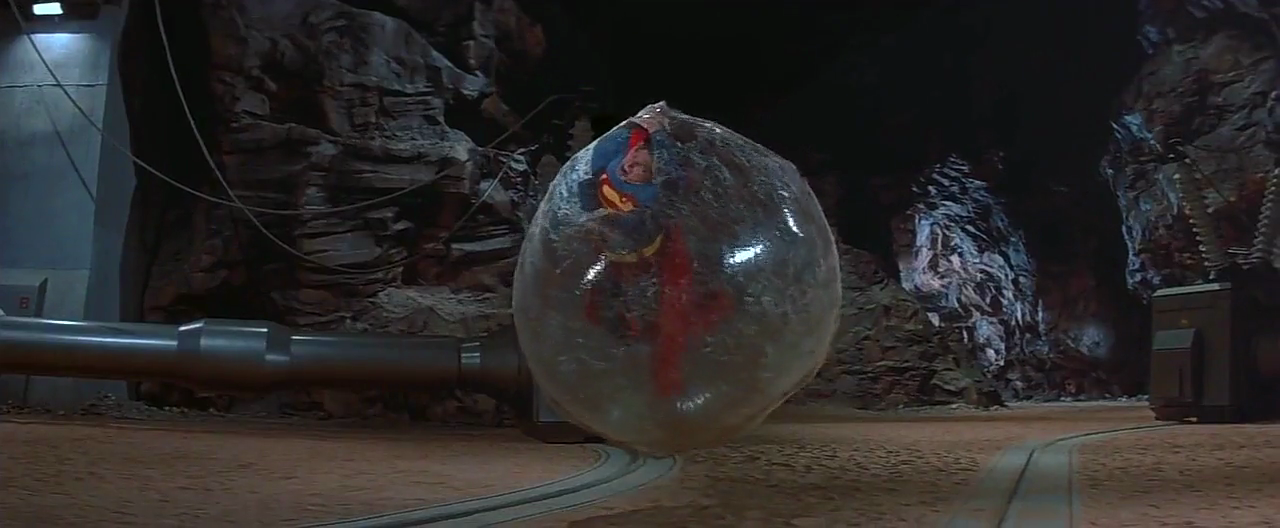
The computer creates one of those Rover Balloons from The Prisoner to capture Superman.


The purpose of this attack, as Frau excitedly says, is to “see how long he can carry on without any air!” Well, he can probably hold it for awhile, since he does go into space often.


Then, it turns out that the computer developed a program that identifies an enemy's weakness and blasts Superman with a ray of pure Kryptonite, possibly killing him. (I know, this makes no sense.) This upsets Gorman who attempts to shut down the machine.


After Gorman unscrews a screw, the machine shuts down. Then he fights and beats Webster in what amounts to a slap fight.


Shockingly, it starts up again almost immediately, causing Gorman to exclaim “It wants to live!“ Much like Clark vs. Superman, this existential dilemma could be interesting as to what constitutes life, and should very much interest Superman. If one of Superman's codes is not to kill living things, wouldn't what to do with a “living” computer be worthy of further analysis?


It's a TARDIS


The computer also has the ability to turn Frau into a robot lady in a sequence that can only be described as highly disturbing.


Note here: When Clark leaves Frau, to the best of our knowledge, she’s still a cyborg. So Superman's leaving a killer cyborg lady that can shoot unstoppable projectiles for the police to contain? Just to hang out with Gus Gorman?


Earlier in the film, Superman saves a burning chemical plant on his way to Smallville. Inside the plant is an acid that, if heated, will eat all metals. During a lull in the fight, Superman flies to Smallville, gets the acid, and uses it to destroy the machine. To the film’s credit, the acid was a minor, forgettable point from the first, forgettable action sequence so using it to conclude the second one was kind of clever on the filmmakers' part.

There you have it. The computer's dead, cops have Webster + crew, Gorman has a job, Lois comes back, Superman re-leans the Straight Tower of Pisa (in the wrong direction) upsetting the racist stereotype, fly around earth, and end.


Conclusion

So Superman III.... 2 hours and 4 minutes where it's well over a half hour before Webster even appears. And a bit longer after that when you realize that Gorman is going to be the major bad guy. Marred with a terrible plot, poor performances, lame comedy, and so many other things that make the 1980s an embarrassing decade for film, is it any wonder that it took nearly two decades for superhero films to earn respect?

And not only is it a bad movie, but the first in the trilogy of terrible “Donner-verse” Superman films.

This is followed by 1987's Superman IV: The Quest for Peace and 2006's Superman Returns, which un-existences Superman III and IV.

Like I said above, I don’t want to concentrate exclusively on superhero movies in this blog. But I haven't entirely decided against doing Superman IV for the next one. Or maybe I'll do Death Wish III, The Love Guru, or something else. It's not as if anybody is reading this.


Email me at cinemasochismblog@gmail.com for any conceivable reason or to suggest a movie.